Why Rotational Smoothness Impacts Performance
Many riders and athletes focus on improving performance through engine tuning, weight reduction, or aerodynamics. However, one often overlooked factor plays a direct role in overall efficiency: wheel rotational smoothness.
On a motorcycle, bicycle, kart, or motocross bike, every wheel rotation depends on a key component: the bearing. If it generates even minimal resistance, that resistance must be compensated by additional engine power or physical effort. Conversely, smoother rotation improves inertia, enhances fluidity, and provides greater consistency at high speed.
The goal is not only to go faster, but to optimize the energy already available. Less mechanical loss means greater efficiency, improved consistency, and better overall performance.
Optimizing Rotation Without Modifying the Machine
There are two main approaches to improving wheel behavior: modifying structural elements (rim, hub, axle) or optimizing the internal components responsible for rotation.
The second approach is often the simplest and most effective: optimizing the bearings.
Conventional Bearings
Standard OEM bearings are designed to provide an excellent balance between cost, durability, and longevity. They use steel balls and are perfectly suited for normal use.
However, under increased stress — high speed, performance riding, repeated loads, and higher temperatures — the material can generate additional friction and heat.
For most users, these bearings perform perfectly well. But for those seeking higher levels of optimization, an alternative exists.
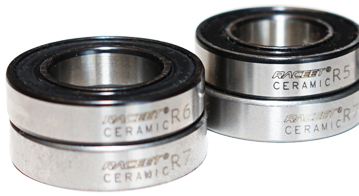
Hybrid Ceramic Bearings
Hybrid ceramic bearings combine technical ceramic balls with precision steel races. The advantage lies in the properties of ceramic: high hardness, low weight, and excellent dimensional stability.
In practice, this results in smoother rotation and improved consistency under demanding conditions. The benefit is not dramatic but progressive: a wheel that spins more freely and for longer.
It is important to understand that manufacturing quality is critical. Not all "ceramic" bearings offer the same level of precision or assembly quality.
Actual performance depends on ball quality, race machining precision, lubrication, and sealing type adapted to the environment (road, track, rain, dust).
Should You Choose Steel or Ceramic?
The debate between steel and ceramic bearings comes up frequently. In reality, the choice depends primarily on your use case.
Steel bearings are perfectly suited for daily or occasional use. They offer reliability and simplicity.
Hybrid ceramic bearings are better suited for demanding users looking to optimize every detail of their machine. The goal is not to radically transform performance, but to reduce cumulative mechanical losses.
In any moving system, performance is not only defined by the power produced, but also by the energy lost along the way.
Both technologies serve the same mechanical function. The difference lies in their ability to maintain smooth, precise, and stable rotation under stress.
It is also important to note that installation, alignment, and maintenance play a major role. A high-end bearing that is poorly installed will perform worse than a properly installed standard bearing.
Choosing hybrid ceramic bearings should therefore be a deliberate decision based on real usage and performance expectations.
Hybrid Ceramic Bearings
- Key Advantages
- Improved rotational smoothness
- Greater stability under intensive use
- Enhanced high-speed consistency
- Superior thermal resistance
- Fine optimization of overall performance